
“We live in little boxes or little bags of belief, and then we look at the cardboard or the paper and we think that’s the world. But it isn’t. It’s an interpretation of the world, a filtered version of the world.”
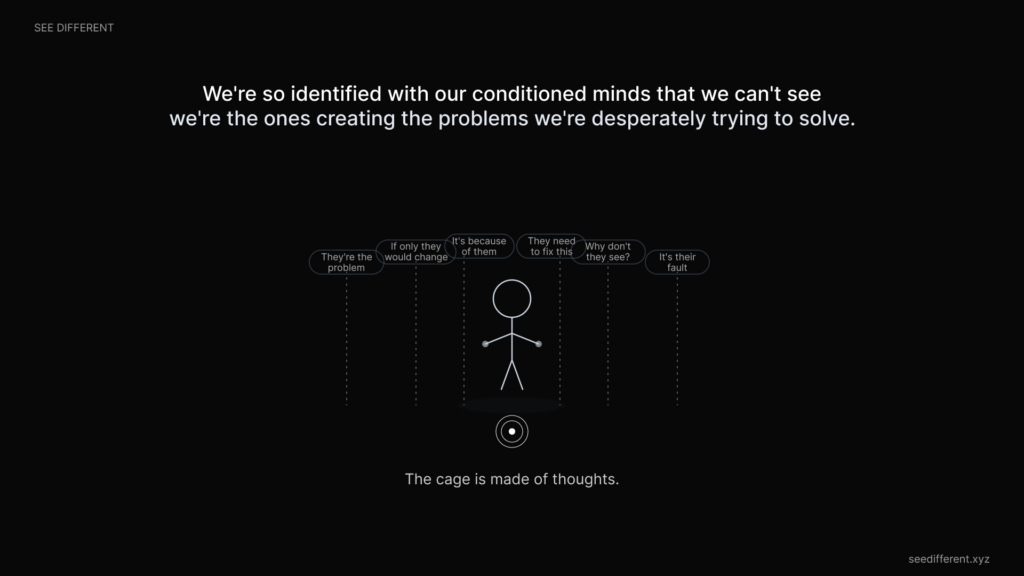
Most of us don’t realize we’re living in a prison. The bars aren’t made of steel—they’re made of beliefs. And unlike physical prisons, we often mistake these constraints for reality itself.
I discovered this during the Sedona Beliefs Course, when a simple question shattered something I’d never questioned: When you look at a tree, do you see the tree itself, or do you see your beliefs about trees?
The answer was humbling. I realized I’d been living my entire life—including my leadership—through inherited filters I’d never consciously chosen.
The Invisible Architecture
The prison of belief operates through what I call the invisible maps that keep us stuck. These aren’t just ideas we hold; they’re the very lens through which we perceive reality. When we think we’re seeing clearly, we’re often seeing through accumulated stories about how things should be.
Consider how we approach leadership challenges. We don’t see the situation as it is—we see it through our beliefs about:
- What leadership means
- How people should behave
- What success looks like
- Why things aren’t working
These beliefs create what the Sedona Course teacher called “little boxes of interpretation.” We live inside these boxes so long that they become invisible, and we mistake the cardboard walls for the actual world.
The Relativity of Right and Wrong
One of the most constraining belief systems involves our sense of right and wrong. Most of the time, honestly, we think we’re wrong and stupid on some level. This programming gets installed early—not maliciously, but through the natural process of correction and socialization.
But right and wrong are completely relative. They depend on upbringing, faith, politics, country of origin, culture. Yet we don’t recognize that these are just beliefs, not truth. As the course revealed, right and wrong are concepts that come from believing we are separate individuals who must defend our position in the world.
In leadership, this shows up as the exhausting need to be right, to make others wrong, to defend our decisions from a place of moral superiority rather than clarity. How much energy do we waste trying to prove we’re not the stupid, wrong person we secretly fear we are?
The Person-Prison
The deepest belief—and the one that creates all the others—is the belief that you are a separate individual who must manage, control, and improve their experience. This seems so obvious that questioning it feels absurd. Yet this is the core belief that creates the sense of limitation, inadequacy, and constant seeking that drives most leadership dysfunction.
What if the very sense of being a person who has problems is just another belief? What if what you truly are needs no belief to exist, just as the sun needs no belief to shine?
This isn’t philosophy—it’s practical. When you’re not defending an identity or maintaining a story about who you should be, there’s a natural responsiveness to what’s actually happening. Decisions arise from clarity rather than confusion. Actions emerge from wholeness rather than lack.
Breaking Free
The way out of the belief prison isn’t through better beliefs or positive thinking. It’s through recognizing that beliefs are temporary appearances in awareness, not solid truths. They’re like clouds passing through an open sky—real as appearances, but not permanent structures.
During the Sedona work, I learned to ask a simple question when caught in limiting beliefs: Does this belief actually belong to anyone?
When you look closely, you discover that beliefs arise and pass away in the space of awareness. That space—call it consciousness, presence, or simply what you are—is already free, already whole, already enough.
The Leadership Revolution
When leaders recognize they’re not their beliefs about leadership, everything changes. They stop trying to be the kind of leader they think they should be and start responding from their authentic nature. They stop managing their image and start serving what’s actually needed.
This isn’t about becoming a better leader—it’s about recognizing that what you truly are needs no improvement. The awareness, wisdom, and authentic leadership capacity you’re seeking isn’t something you need to develop; it’s something you need to uncover by seeing through the beliefs that seem to obscure it.
The belief prison is both the problem and the opportunity. Once you see that you’re looking through inherited filters rather than at reality directly, those filters become transparent. You’re still in the same world, dealing with the same challenges, but you’re no longer trapped by unconscious interpretations of what they mean.
The Freedom That’s Already Here
The miracle isn’t that you can escape the belief prison—it’s recognizing that what you truly are was never imprisoned. Beliefs appear and disappear in awareness, but awareness itself is unbound by any belief about it.
This recognition transforms leadership because it reveals that consciousness itself is what you are. When you stop trying to manage your experience from the outside and recognize the source from which all experience arises, leadership becomes as natural as breathing.
The prison door was never locked. The key was never hidden. You are both the prisoner and the freedom you’ve been seeking.
What belief about yourself or your leadership would you be willing to question today?
