
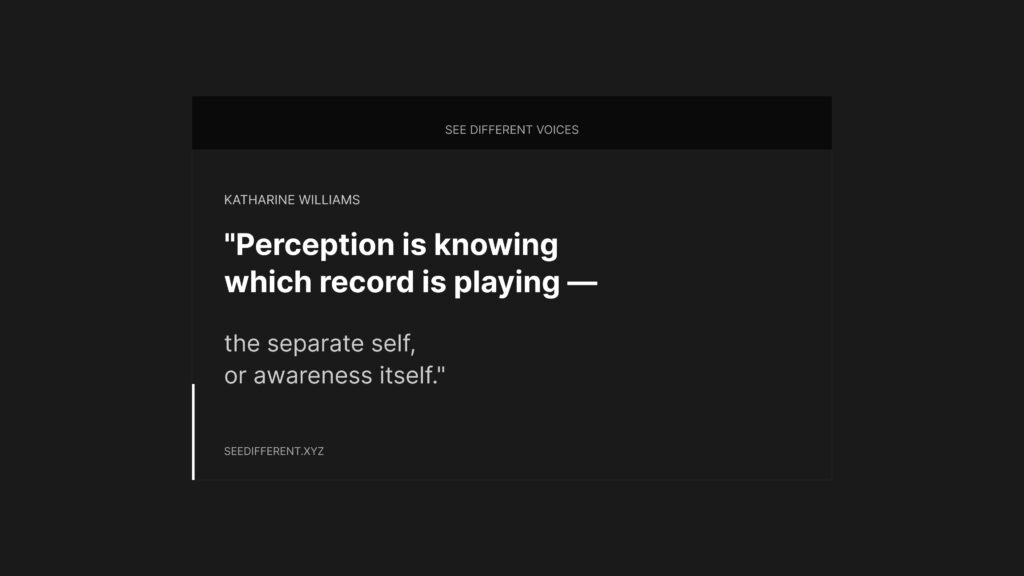
In this conversation, Katharine Williams describes perception not as a concept, but as occupancy. It’s the subtle yet decisive shift between the voice of the separate self and the spaciousness of awareness itself.
1. What does perception mean to you?
My understanding of perception has changed a lot over the past few years, and it may change again. But where I am now, perception means: from where am I looking?
I used to be a DJ, so I think of it like two turntables and a crossfader. On one side is my separate self — Katharine, with her body, her history, her personality. On the other side is everything that ever has been and ever will be — what we might call spirit.
When my consciousness shifted, I realized that in any moment, the key question is: Where is the crossfader? Which record is playing? Which source is coming out through my eyes?
So perception became about occupancy. What is occupying my awareness right now? Is it the separate self, or is it awareness itself?
I can look at any situation from here or from here. That choice — or that noticing — is perception.
When people ask what this shift feels like, I can’t really put it into words. For me it’s like a tiny movement backward and a sense of openness.
I once heard Adyashanti speak about acceptance. He said the ego cannot accept life as it is — it’s not designed to. It can tolerate or reframe, but it cannot truly accept. Awareness, however, is acceptance. Because everything is happening within it, it accepts everything.
So it’s not about me trying to accept. It’s about resting as awareness — and becoming acceptance itself.
That understanding helped me relax when I notice I’m not “accepting.” If the separate self is playing, acceptance won’t be possible. So instead of forcing it, I just notice which record is on.
2. For much of my life, I never connected perception with leadership. Has that been true for you? When did you first notice the connection?
Absolutely.
Early in my career, I thought leadership meant knowing the most, being the most experienced, having the best ideas. I didn’t even really recognize that other perspectives had value — which is uncomfortable to admit, but that’s where I was.
Not just that there were vast alternative perspectives — but that even five centimeters away from mine was another valid view worth listening to.
Now my leadership roles are different. I lead community. I coach. I consult. And perception has unlocked something profound.
When I’m working with an individual or a team that feels challenging, I can see their behaviors and actions — and at the same time see that behind all of it is a beautiful, perfect soul.
So I’m holding two views at once:
- Something here may need support or intervention.
- And it is all completely perfect.
Learning to hold that dual awareness is my life’s work.
My leadership is far less directive than it once was. There is still action — but I’m no longer collapsing possibility around my own preferred outcome.
Previously, I would have had a clear direction, a clear answer, and moved toward it. That collapses probability. Now, I try to intervene while keeping possibilities open, because my idea is almost certainly not the best one.
My job is to remain open enough for the situation’s own intelligence to unfold — rather than directing it from my ego.
And truly embodying “I don’t know” creates space. Conversations go places I never anticipated. Something wiser emerges.
3. When in your life did a shift in perception change everything?
There have been many. But I’ll share one recent example.
My brother married a beautiful woman from a devout Muslim family. The wedding was full of unity — different cultures, backgrounds, traditions coming together in love.
At the same time, outside in London, there were right-wing anti-immigration marches happening. It felt poignant that this wedding of unity was happening while division marched outside.
In my speech, I spoke about how this — love, unity, coming together — is what becomes possible when humans operate from their highest expression.
The following week, the bride’s father confronted me and said my speech was inappropriate. He strongly disagreed with what I’d said.
Initially, I was upset. But very quickly, perception shifted.
It stopped being about me. It wasn’t personal. I had held up a mirror to compassion and unity — and that mirror was uncomfortable for him.
From a broader perspective, it became a beautifully orchestrated moment. Our soul’s evolution is interwoven. He needed to hear that. I needed to hear his reaction.
It even felt like a test of conviction — a week before I was due to speak publicly again.
Seeing it from that wider lens transformed it from a personal attack into a gift.
4. Joseph Jaworski wrote: “If we could only see reality more as it is, it would become obvious what we need to do.” What has helped you see reality more clearly?
For me, it’s been the Bwiti spiritual tradition I work within.
In that tradition, you don’t receive teachings without experience. Everything is experiential. The deepest teachings come through ceremony — through visions, sensations, direct knowing.
When I’m in that environment, magic is everywhere. Synchronicities aren’t small coincidences. They are intricately woven sequences of events that feel designed across decades.
When you begin to “peek under the hood” of what my teacher calls the universe’s “high technology,” you cannot return to seeing life as random.
Even in difficult moments, you know there is an intelligence operating.
That perspective changes everything — including how I relate to my own frustrations.
There are moments in my life now that aren’t exactly how I’d prefer them to be — financially or practically. And then I remember: I’ve been allowed to glimpse this vast intelligence and energy. And here I am complaining about a tiny physical inconvenience.
The perspective becomes almost humorous.
5. If you could help everyone see one thing more clearly, what would it be?
The phrase that comes to me is: “The door will open when it’s time.”
I received that message in a sweat lodge. I was in psychological distress, wanting the door to open because it was too hot, too intense.
And the message came: The door will open when it’s time.
When I wasn’t obsessing about the door, I was fine. When I wanted it open on my timeline, it was hell.
That teaching changed everything for me.
So much of our suffering comes from time — things not starting or ending when we think they should. Good things taking too long. Bad things lasting too long.
We create suffering by arguing with timing.
“The door will open when it’s time” lets the air out of the tires. I don’t have to kick down doors. I don’t have to force outcomes.
When the timing is right, it opens.
6. What’s true for you right now?
I’m here.
And I don’t know.
And that’s okay.
I don’t know what will happen in ten minutes. I don’t know what will happen in my life, my daughter’s life, my business, my parents’ lives.
But I know I will be aware of whatever happens.
And it will be fine.
This conversation is part of the SEE DIFFERENT Voices series—explorations into perception, awareness, and how reality is revealed when we learn to see differently.

Leave a Reply