
For Ruth Davey, leadership begins with attention. When we slow down and truly see, new stories and new possibilities become available.
1. What does perception mean to you?
For me, perception is very nuanced—it has many layers. Perception can mean what I see with my eyes, my actual vision. It can mean what I see in my mind, in my imagination. And sometimes it’s a mixture of both of those things.
More and more, it’s about what I see in my head—my mind, what’s going on there. But if I get out of my head, how do I see or perceive the same thing coming from a place of heart rather than head? And does that change? Often it does.
And not just the head and the heart, but also in a more embodied way. I often use the head, heart, hands framework. Seeing with the hands might involve touch if it’s the actual hands, but “hands” is more a word to describe the body as a whole. How does my body feel or perceive things? That might be very different again to how my head perceives things.
I also sense into the idea of the higher self, higher power, source energy, universal love, God—whatever words we might use for it. The other stuff that’s going on that I’m sensing more and more in my life, and how does that affect the way I see things?
I can perceive things from an individual perspective—from me as an individual human being—and I will perceive something one way. Yet if I perceive the same thing with a sense of the collective, from a wider sense of humanity rather than just one individual, again my perception will change.
What really intrigues and fascinates me—and this relates so much to my work with looking and looking again and actually seeing—is how this idea of seeing changes from an individual level right up to the planetary level. I include the more-than-human, not just humans. How does perception change depending on how all of those individuals perceive things? We will all perceive the same thing probably a bit differently, but we don’t recognize that.
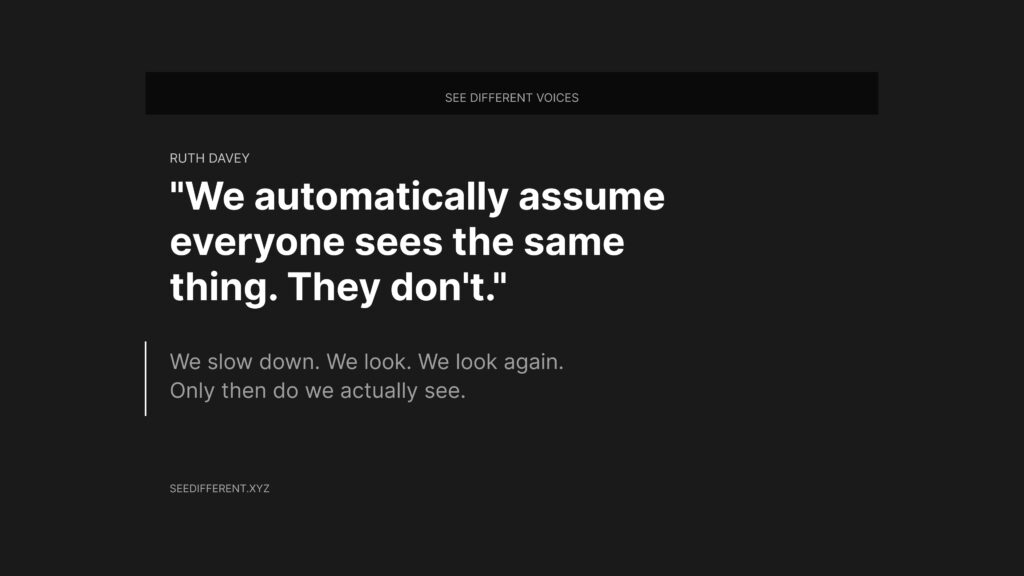
We automatically assume everybody sees the same thing the same way we do. It’s so important to recognize we probably don’t.
I often use a practice that involves a glass—like an empty glass or a glass of water. Imagine there’s 10 people in the room. Everyone has the same glass and everyone is invited to look at that glass and experience it, not just necessarily with their eyes but through all the senses—they might want to feel it, smell it. Then invite people to create one image of that glass. Everyone will create a very different image, and yet it’s the same mundane object. For me, that’s a nice little practice that illustrates how important it is to recognize that people see everything differently.
2. For much of my own life, I never connected perception with leadership. Has that been true for you? If so, when did you first notice the connection?
Until a few years ago, I don’t think I seriously considered myself a leader, full stop. I had this perception that leaders were kind of up there somewhere—these amazing people that I used to put on a pedestal. I’d think, “Oh, they’re amazing,” almost bowing down to them. They might be amazing or might not be amazing, but basically people that weren’t me. People who knew more, who were often more academic, who had more intellectual knowledge, who were well-read, who had loads of letters after their names, or who were leading amazing organizations. So, you know, they’re the leaders—they’re over there.
Then I started to realize, no, actually that’s one way of looking at leadership. I was in a situation where I signed up to go on a one-day workshop in nature facilitated by this really lovely English man called Giles Hutchins. He had invited leaders to this day, and as I read the information, I realized that what he was referring to was people like me. I thought, “Oh, that’s amazing!”
That day we actually went through the Theory U process in nature. A lot of it was related to Theory U—I didn’t know much about it at all at that point, but it resonated so much with me. The idea of literally seeing with fresh eyes was something I was doing all the time, but I hadn’t seen it within that leadership space or how it could be used in so many other ways. It was one of those days in my life—things haven’t quite been the same since then.
It’s really interesting because my dad was a leader in his own right and very much seen as a leader. He died about 30 years ago now when I was 25. He was very much seen as a leader—not in a corporate setting at all, anything but corporate—but he had a team of over 100 people that he was leading.
When I look back on my childhood and adolescence, I was often at the front. We’d go on walks and I would be up there with the adults, often with the men. I didn’t want to hang about with the women—I was up there. When I look back now, I can see that actually there was courage, there was strength. I feel like I have a lot of skills and attributes that are more typically considered to be leadership-related.
On the other hand, what I’m also realizing through the last few years—so many of the softer skills, inner skills that I feel I’ve always had in a very natural way don’t involve lots of intellectual knowledge. It’s more emotional intelligence, heart intelligence. That’s something I feel very, very privileged to have actually. I’ve been taking that more seriously over the last few years.
3. When in your life did a shift in perception change everything?
A massive thing was 10 years ago when I was experiencing a lot of anxiety and depression. I was getting closer and closer to burnout, but I didn’t know what burnout was at that point. My body just stopped working. I could hardly get out of bed one morning. It was literally 10 years ago. My son was only 12 at the time and I needed help. So I did something I’d never done in my life before—I called my mum. She came and stayed with me. I’d never done that before, so I must have been really desperate. I needed a lot of support. My son needed to get to school and I needed to feed him, but basically I had to totally surrender to what was happening in my body, which was burnout. It was really frightening.
As part of my recovery from that process, I asked myself: What do I love? What do I love in this life? It had been work, work, work. I mean, I never earned much money, but it wasn’t about that for me. My work’s always been about social justice, always been around supporting people to be seen for who they are rather than for what the world wants them to be—though I didn’t know that at the time.
I started to focus on myself. I thought, well, what do I love? I love photography. I love nature—I’ve always loved being in nature. I’d got into mindfulness, but I found conventional mindfulness—sitting for a long period of time or lying down doing body scans—really, really challenging, and I didn’t know why at the time.
To cut a long story short, over a period of weeks and months, I started to very intuitively put those three things together and created what became the Look Again methodology—literally slowing down in order to see differently. We slow down, we look, we look again, and it’s only then that we actually see. That’s now been researched and we’ve gone out to thousands of people around the world, offering it through courses but also lots of work with non-profits as well as the public and private sector to support others to see differently.
I think sometimes life brings something along the way and we can either seize it as an opportunity to reflect and to trust—trust the unfolding. When you’re someone like me who at the time was experiencing serious anxiety and fairly full-on depression, you can’t see beyond the darkness. Very slowly, and largely through being in nature, I always managed to find the light. It was then trusting that the light would show me, that nature would show me, that nature would teach me.
I still learn from nature all the time. When I feel like I need a sense of nourishment and closeness, I go into the woods where I feel held by the trees in a more enclosed space. When I feel like I really need a wider perspective—I need to literally stand back and see the bigger perspective—then I go up onto the hills so that I have that big sky.
For me, the practices can be done anywhere. In essence, what our work’s about is that wherever you are, you can use your sight or your imagination to look down, look up, look left, look right, look in front, but don’t forget to look behind. And this sense of looking in as well as looking out.
It’s not just about looking and seeing in new ways what is easy or pleasurable or pleasant. More and more, it’s about how can we use our sense of perception to look at what is difficult—personally—but where this becomes really, really interesting and transformational from a collective perspective is if you get a group of people doing this. When there’s something challenging to look at and you do this in a way that people realize, “Oh, actually we thought everyone was seeing this the same way, and now we’re realizing everyone’s seeing this totally differently.” So how does that work?
How can we use perception—and in our case, the act of creating images as well—to create a new story? This isn’t about just the story that is. It’s about creating a new story that could come, using our sense of vision and perception and imagination to have agency to create something new that hopefully is positive and healthy and hopeful.
4. Joseph Jaworski said in Synchronicity, “If we could only see reality more as it is, it would become obvious what we need to do.” What has helped you see reality more clearly in your own life or leadership?
For me, it’s seeing what is literally in front of me. That thing of bringing in the idea of the beginner’s mind, the child’s mind—forgetting everything we think we know in our heads. Actually, forget all of that. What can I see literally here right now?
If I was to do this now, I could close my eyes, spend a few moments in quiet, in stillness, and then open my eyes again. What can I see? I can look at my floor—we literally do this with people. Look at the floor. It’s pretty mundane, but every time I look at that floor, it’s different because the light’s different or there’s something I’ve brought in from outside or there’s a bit of fluff. It’s always something different. Things don’t stay the same. From one moment to the next, wherever I am, I can literally, with intention and with curiosity, with awareness and consciousness, think: Right here, right now, what can I see? What is literally here? It could be something really simple or it could be something really complex.
Something I haven’t shared that feels important and was all part of the burnout thing—I didn’t realize at the time that I have ADHD. As someone who’s neurodivergent, the way I see is different. I now know that what I’ve experienced in terms of the anxiety, the depression, the struggles I’ve had, were largely because I was not being seen for who I am, but I was not seeing myself for who I am because I was trying to be normal.
Now that I don’t have to be normal anymore, I can just be myself—it’s like, yay, I’m free! But part of that means I find intense noise quite difficult and crowds quite difficult. Whereas before I might have dealt with that by having a beer to steady the nerves a little bit, now I don’t drink at all. But I will use my sight to help ground me wherever I am.
Right here, right now, in a busy whatever it is, what can I see? In a busy situation like that, I might actually focus right in on something very small in front of me, and that will often support me to reframe what I’m feeling. I will find the calm to deal with the situation.
Imagine a situation where there’s a big team of people and there’s some awful thing coming and everyone’s really anxious—maybe they’re losing their jobs or whatever. It’s like, okay, let’s slow right down. What can we see? What is there? Then share those stories. That’s a really important part of this, I think—certainly our approach with Look Again is sharing our inspiration, sharing our insights, sharing our photographs, sharing our stories. Then we can create a new story—in a team or collective situation—that is really aligned to the values, to the future vision of whatever the issue is about.
5. If you could help everyone see one thing more clearly, what would it be?
It’s that thing of encouraging people to slow right down and see what is in front of them. I truly believe that the answers to so many of the things that we’re anxious about or that we’re concerned about are literally in front of us—in our homes, in our gardens, in nature, wherever it might be. It’s just that we’re so busy walking around we don’t actually see. We don’t use our sense of sight to learn and to feel and to learn and feel differently.
There’s this little thing I like saying: If we learn to see differently, we can be different. And by being different, we can then make an active, intentional choice to do different. See, be, do differently.
This conversation is part of the SEE DIFFERENT Voices series—explorations into perception, awareness, and how reality is revealed when we learn to see differently.

Leave a Reply