
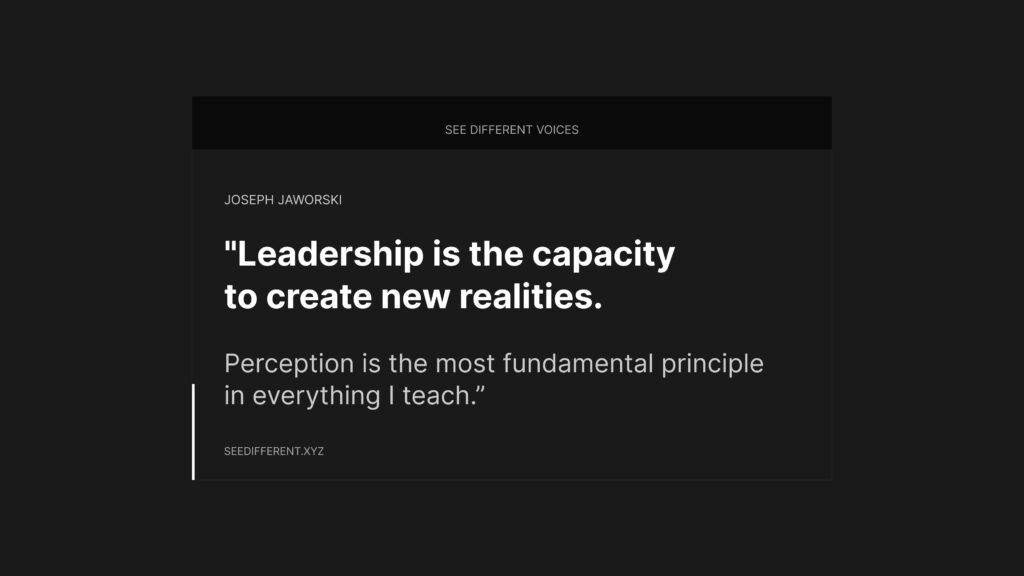
Joseph Jaworski has spent a lifetime exploring a simple truth: leadership does not begin with action, strategy, or vision, but with perception.
1. What does perception mean to you?
When I saw that question, it was like electricity going through me because it’s everything. In the way I study, learn, and teach leadership, perception is the most fundamental principle in everything I do.
A good example is a story I share in the epilogue of Synchronicity about Pierre Wack — the legendary scenario planner at Shell. He described what he learned as “the art of seeing.” He only revealed how he learned it late in life, in an essay written near the end. He attributed his capacity to see current reality and develop foresight to years of learning with a master in India — fifty sittings over thirteen years, sometimes lasting weeks.
Shell famously foresaw the 1973 oil crisis and prepared years ahead of competitors. Pierre attributed that capacity to those teachings — and for me, it’s a powerful example of how effective this work can be when you truly learn to observe deeply and see: to see current reality, and to see into what’s coming.
2. For much of my life, I never connected perception with leadership. How did that connection occur for you?
I remember writing, even before Synchronicity, that leadership is the capacity to create new realities.
Perception and leadership come together in what we call the U-process — a core process we discovered during a major engagement around 2000, when Saudi Aramco formed an alliance with Shell and Texaco and combined downstream operations. The CEO inherited a workforce raised in traditional oil companies — “elephants,” moving slowly — and told them they were facing startup competitors who moved like “gazelles.” His message was: if we don’t learn to operate like gazelles, we won’t be around in five years.
When someone asked him how to do that, he said, “I haven’t got a clue.” The next morning, I told him I knew half the formula, and if he gave me nine months, I’d come back with the whole thing. He funded the work, and we built a leadership lab that taught what became the U-process.
At its core are three coordinates:
- Observe, observe, observe — take whatever time it takes to understand current reality. If you get this wrong, you’ll disrupt the whole process.
- Let go — release preconceived notions and drop into beginner’s mind.
- Go to the deeper place of knowing — connection to source (what we call the implicate order).
- And then: Act in an instant — when action is clear, it can be swift.
Accurate perception sits at the center of that whole process.
3. When in your life did a shift in perception change everything?
Two moments stand out.
First: when I was 13 or 14, working on my family ranch. I had a mentor, Curlow Morris — a wise man who taught me something that became a life lesson. He said the Cherokees taught them to hunt this way:
“Walk one step and listen two. Walk one and listen two.”
He taught me that observation is the foundation of success — not just in hunting, but in everything. I would stay out in the woods for eight or nine hours practicing that. It became a way of life: slow down, observe, reflect, wait.
Second: when I was approaching 50, living in London as a lawyer. I had a burning desire to form the American Leadership Forum in response to Watergate — to help leaders transform themselves and heal fragmentation in their communities. I didn’t know how to do it. I resigned anyway.
The next morning, after a run in Hyde Park, I opened the Sunday Times and it fell open to a headline: “David Bohm discovers the algebra of algebras.” I had just seen Bohm’s book The Implicate Order — and the headline hit me like lightning.
I called him. Somehow I reached him at home. I poured my heart out. He said, “Mr. Jaworski, I’m clearing my schedule for tomorrow. I’ll see you at 10 a.m.” That meeting was life-changing. He spent the day teaching me — essentially, teaching me how to seek.
4. What has helped you see reality more clearly in your own life and leadership?
Following a disciplined path toward clearer seeing has been the secret to my success in this work. For me, that includes:
- Qigong — I practice every morning, 10–30 minutes.
- Meditation — sometimes three times a day, at least once.
- Nature as teacher — long walks in nature, practicing beginner’s mind.
When I walk, I imagine I’m walking with a three-year-old — seeing everything fresh. I can walk the same path for a year and see something new each time, if I truly practice that.
5. If you could help everyone see one thing more clearly, what would it be?
One is foundational: use the U-process as your core process — personally, at work, at home. It works at every scale.
And the other is this: harness the energies of love and operate from love instead of fear. There’s a whole session we could do on the power of love, but it’s something I’ve studied and believe deeply.
This conversation is part of the SEE DIFFERENT Voices series—explorations into perception, awareness, and how reality is revealed when we learn to see differently.

Leave a Reply