
Susan Taylor reflects on perception as a lived capacity—one that shapes leadership, Dialogue, and our ability to see reality as it is.
1. What does perception mean to you?
For me, perception is much more than what we see. It’s how we receive the world.
It’s a synthesis of our senses, experiences, beliefs, and even the quiet whispers of intuition—especially when we’re able to slow down and become still. Perception shapes how we interpret events, how we relate to others, and how we make meaning of our lives.
What’s important to me is that perception isn’t static. It has the capacity to expand when the right conditions are present. The more open and aware we become, the more possibilities we’re able to sense into—and that’s often where transformation begins.
Spiritually, perception goes beyond noticing something with the senses. It’s about receiving truth as it is from my own experience, without the filters of ego, fear, and past conditioning. It’s a willingness to be with what I feel to be true, even if I don’t agree with it or understand it yet.
If I were to sum it up in one sentence:
To perceive, in the spiritual sense, is to see with the eyes of the soul—beyond appearances, beyond judgment—into the deeper truth and wholeness of what is.
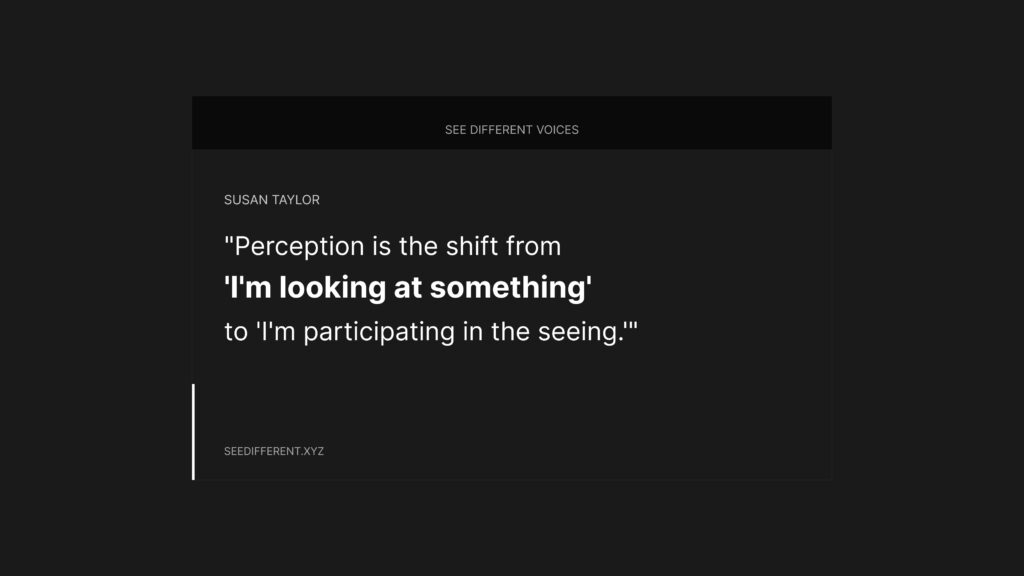
When perception shifts in this way, it’s no longer “I’m looking at something.”
It becomes, “I’m participating in the seeing.”
That’s where awareness and Dialogue come together. Dialogue, for me, isn’t just a conversation guided by principles—it’s a state of being. A way of being in relationship with what’s unfolding.
2. For much of my life, I never connected perception with leadership. Has that been true for you?
Actually, I’ve had the opposite experience.
I didn’t use the word perception at the time, but I understood the connection very early. When I was 28, I started my own business while on maternity leave with my first daughter. What I could see—very clearly—was that the biggest gaps in business weren’t about strategy, profit, or growth platforms. They were about people.
At that time, there wasn’t much awareness of the human dimension of work. But I could sense that a leader’s ability to truly see people—to notice undercurrents in relationships, culture, and systems—was not a soft skill. It was a strategic advantage.
That understanding is what led me to start my company and to focus on bringing the human condition back into business. It shaped my entrepreneurial path and later my work with Joseph Jaworski and others at Generon.
For me, leadership has always been inseparable from perception—the capacity to see people, to value them, and to sense what’s really happening beneath the surface.
3. When in your life did a shift in perception change everything?
One of the most pivotal moments came through my practice of Bohmian Dialogue.
The disciplines of slowing down, suspending judgment, and listening without an agenda fundamentally changed how I showed up. Instead of worrying about how I should perform—especially in rooms where there were clients, senior leaders, or people I admired—I learned to be present with the rhythm, energy, and people in the room.
When that happens, something very tangible shifts. Conversations soften. Time feels different. New insights begin to emerge—not because anyone is trying to be clever, but because the conditions allow something deeper to surface.
That experience helped me realize that perception isn’t about seeing more clearly so you can find the right answer or strategy. It’s about participating in creating the conditions where reality can reveal itself.
For me, that also meant letting go of certain perceptions I carried as a younger woman leader in a predominantly masculine business world. When I stopped trying to prove myself and instead came with a beginner’s mind, everything opened up.
That’s when I knew I wanted to help others experience this way of being—if they chose it.
4. Joseph Jaworski wrote, “If we could only see reality more as it is, it would become obvious what we need to do.” What has helped you see reality more clearly?
Two things stand out for me: stillness and Dialogue.
Stillness can take many forms—meditation, time in nature, pausing during the day, even stepping away from the computer. Anything that changes the noise-to-signal ratio. When the noise quiets, we’re able to perceive more directly.
Dialogue then brings multiple perspectives into the field. Whether alone or with others, reality becomes less filtered through my own lens and more co-discovered—with others, or with life itself.
What this quote ultimately points to for me is acceptance. I don’t believe suffering is required. I think suffering often comes from an unwillingness to accept what is.
Acceptance doesn’t mean agreeing or condoning. It means being open to current reality as it is. And when that openness is present, clarity often follows naturally. What to do becomes obvious—not forced.
That’s where the real magic is.
5. If you could help everyone see one thing more clearly, what would it be?
I would want people to see that they are not separate from the whole.
When we understand ourselves as part of an interconnected web—whether in a team, an organization, a community, or life itself—we begin to act with more care, courage, and compassion. We stop chasing and start participating.
So many of our challenges come from the illusion of separateness. When we externalize problems, we fragment. We fall into blame, either/or thinking, winning and losing.
But when we see the whole, everything changes.
What if we could shift from seeing things as “out there” to recognizing that what’s happening in me is also happening in you? That shift alone could transform how we meet conflict, difficulty, and difference.
It becomes less about who’s right or wrong and more about how we move through things together—from a place of awe rather than competition or fear.
Seeing the whole changes everything.
This conversation is part of the SEE DIFFERENT Voices series—explorations into perception, awareness, and how reality is revealed when we learn to see differently.

Leave a Reply